How to Hire Freshers for a Startup: Channels, Screening and Offers (2026 Guide)
Karan Saini · 19 Nov 2026 · Career & Interview Prep
Key Takeaways
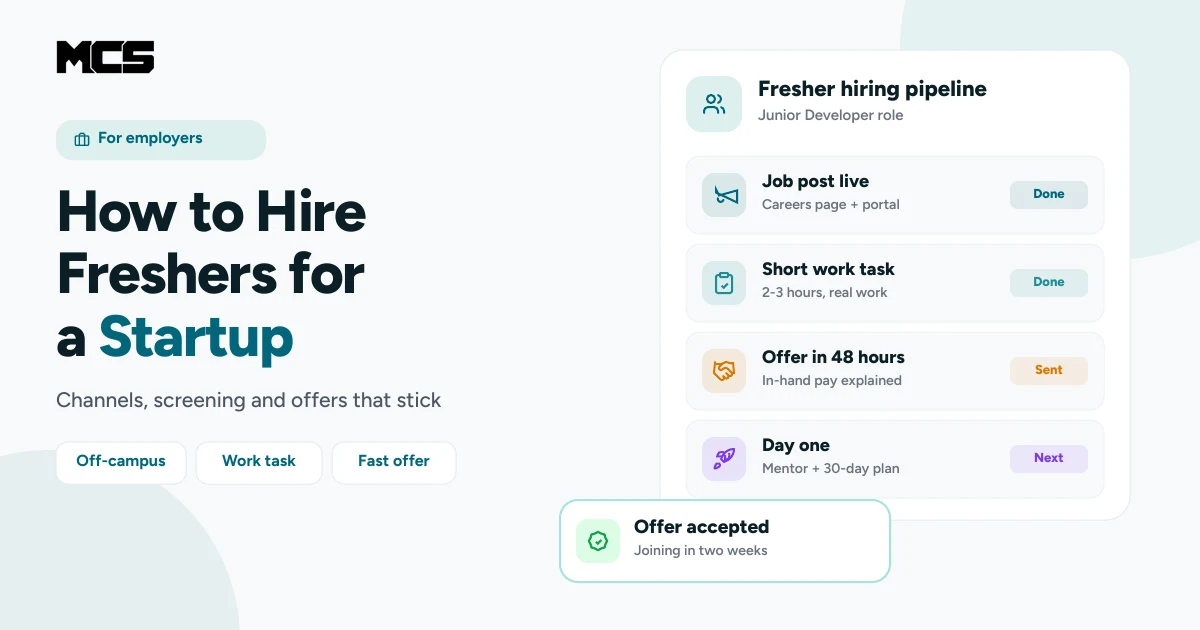
- To hire freshers for a startup, hire for learning speed and attitude, not for a long list of tools. A fresher who learns fast becomes productive in a few months.
- Use the channels that cost little: your own careers page, off-campus job posts, college placement cells near you, referrals from your team and free employer portals.
- Replace long aptitude tests with one short, paid-time-friendly work task (2-3 hours) that looks like the real job.
- An internship-to-hire route lets both sides test the fit before a full-time offer.
- Most fresher offers in India are lost between offer and joining. Keep the gap short, stay in touch every week and make the first 30 days clear.
The best way to hire freshers for a startup is to write a clear, honest job post, source from low-cost channels (off-campus posts, nearby colleges, referrals and employer portals), test candidates with one short task that looks like the real work, and close the offer quickly with a short gap to joining. Startups cannot match big-company brand names, so they win on speed, real ownership and a personal hiring experience.
This guide is for founders, early HR hires and hiring managers in Indian startups who want to build a team of freshers without a big recruiting budget. It covers where to find freshers, how to screen them, campus vs off-campus vs internship routes, how to make an offer and how to reduce offer drop-offs.
Table of Contents
- Why Should a Startup Hire Freshers?
- Before You Post: Define the Role in One Page
- Where to Find Freshers for a Startup
- Campus vs Off-Campus vs Internship-to-Hire
- How to Screen Freshers: A Short Work Task Instead of an Aptitude Test
- Interview Rounds That Work for Startups
- How to Make an Offer Freshers Actually Accept
- How to Reduce Offer-to-Joining Drop-Off
- How to Hire Freshers for a Startup: 8-Step Checklist
- How My Career Solution Helps Employers
- FAQs
Why Should a Startup Hire Freshers?
Freshers are often the right first or second hire for a growing startup team. They are not a cheap shortcut, but they bring clear advantages when you can give them some guidance.
- They learn your way of working: a fresher has no old habits from another company. They pick up your tools, code style and processes from day one.
- They are usually available quickly: most freshers have no notice period, so they can join in two to four weeks. Experienced candidates in India often have 30-90 day notice periods.
- They are motivated by ownership: many freshers want real work and fast learning more than a big brand name. A startup can give them both.
- They grow with the company: a fresher who grows with you for two or three years understands your product deeply and can later train new joiners.
The trade-off is mentoring time. Somebody on your team must review work, answer questions and give feedback, especially in the first three months. If nobody on the team has time for that, hire one experienced person first and add freshers after.
Before You Post: Define the Role in One Page
Most startup hiring goes wrong before the first resume arrives. The founder writes "need a smart fresher for tech and marketing" and then gets 400 resumes that fit nothing. Spend 30 minutes and write a one-page role brief first.
- Role title people search for: "Junior Software Developer", "Associate Data Analyst", "Business Development Associate". Avoid made-up titles.
- What they will do in the first 90 days: three or four concrete outcomes, for example "build and ship two API endpoints with tests" or "call 40 leads a day and update the CRM".
- Must-have skills (max 5): only what you will actually test. For a developer, maybe one language, Git basics and SQL basics.
- Location and work mode: office area, onsite or hybrid, working days.
- Salary range and any stipend: freshers compare offers by monthly in-hand pay, so be clear about fixed pay vs variable pay.
- Who will mentor them: name the person and the weekly check-in time.
Turn this brief into a public job post. Our job description template for software developers has a copy-paste format and a fresher sample you can adapt for any role.
Where to Find Freshers for a Startup
You do not need an expensive job board package to find good freshers. Mix three or four low-cost channels and track which one gives you people who reach the final round.
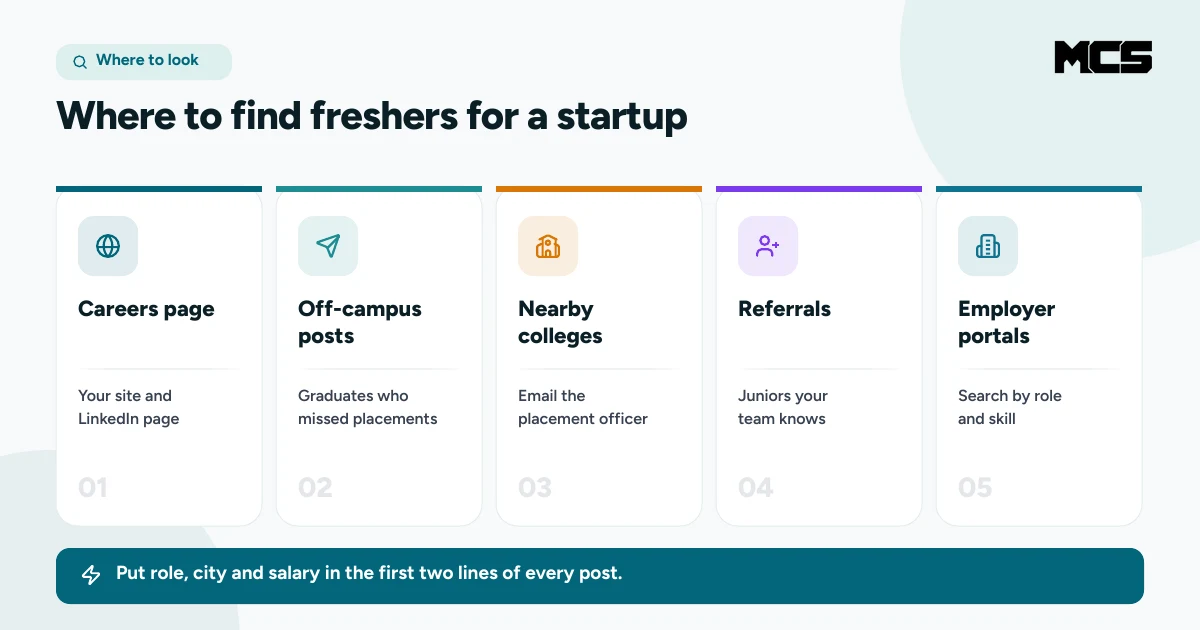
- Your own careers page and LinkedIn page: post every role with a short, honest description. Ask your team to share it. Freshers often look up a startup's website and LinkedIn before they apply.
- Off-campus job posts: many graduates who missed campus placements actively search for off-campus openings. Our guide on off-campus drives for freshers shows how candidates look for these roles, which helps you write posts they will find.
- Nearby colleges: email the training and placement officer (TPO) of 5-10 colleges in your city. Smaller colleges are often happy to share a startup opening with final-year students and recent graduates.
- Employee referrals: ask your team for juniors from their college, coding clubs or past internships. A small referral bonus works well, and referred freshers usually understand what the startup is like before they join.
- Communities and hackathons: college tech fests, open-source contributors and local meetups are good places to find freshers who already build things.
- Employer portals: post the job and search candidates by role and skill on the My Career Solution employer portal, where candidates who are actively looking for jobs keep their profiles and resumes.
Tip: put the role title, city, salary range and "freshers welcome" in the first two lines of every post. Freshers scroll fast on their phones and skip posts that hide these details.
Campus vs Off-Campus vs Internship-to-Hire
There are three common routes to hire freshers. Each one suits a different stage of a startup.
| Route | Best for | Pros | Watch out for |
|---|---|---|---|
| Campus drive | Hiring 5+ freshers at once, usually once a year | Many candidates in one day; the college handles scheduling | Fixed placement calendars; big brands get the first slots; long gap between offer and joining |
| Off-campus hiring | Hiring 1-5 freshers any time of the year | Flexible timing; candidates join quickly; wider pool of colleges | Many unfiltered applications; you need a quick screening step |
| Internship-to-hire | Roles where fit is hard to judge in interviews | Both sides test the fit on real work for 2-6 months | Interns must get real work and fair stipends; set the conversion criteria on day one |
For most early startups, off-campus hiring plus a small internship-to-hire program works best. Campus drives make sense once you hire freshers in batches.
How to run internship-to-hire well
- Write down the conversion criteria on day one, for example "ships 3 features without major rework" or "handles 30 customer chats a day with good ratings".
- Give a fair stipend that is paid on time every month.
- Have a mid-point review and tell the intern honestly where they stand.
- Decide on conversion at least two weeks before the internship ends, so a good intern does not accept another offer while waiting.
How to Screen Freshers: A Short Work Task Instead of an Aptitude Test
Freshers have no work history, so resumes look alike. Long aptitude tests filter for test-taking, not for the job. A short work task tells you much more.
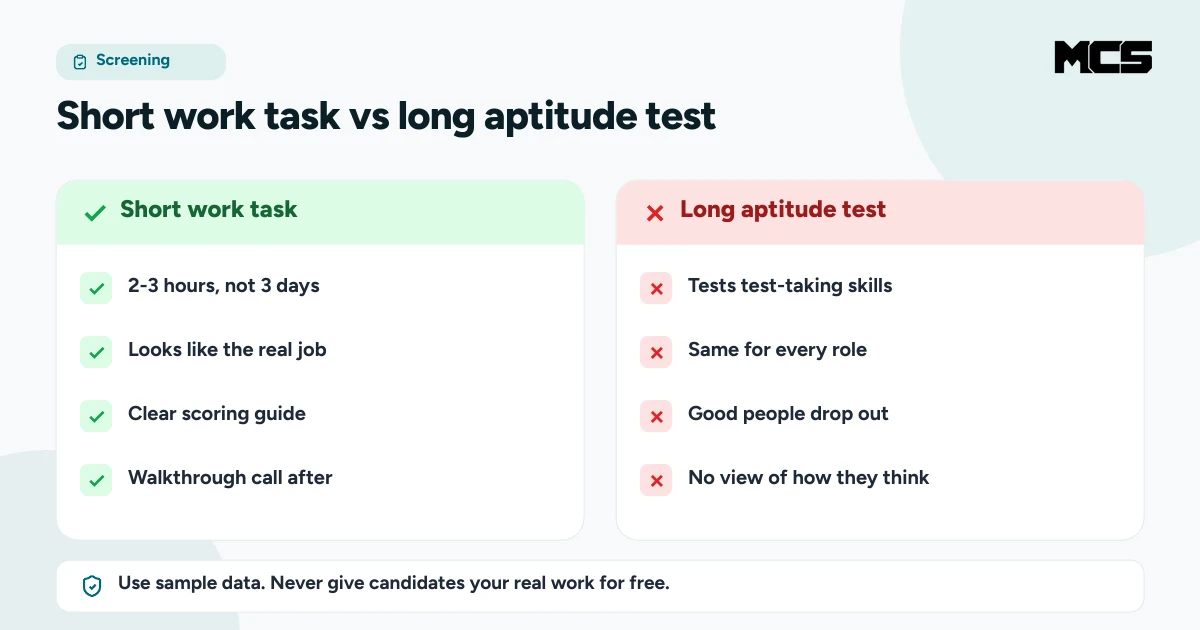
- Keep it short: 2-3 hours of work at most. A 3-day assignment makes good candidates drop out, especially those who already have other interviews.
- Make it look like the real job: fix a small bug and add one test; clean a small CSV and answer three questions in SQL; write a cold email and a follow-up for a real-looking lead.
- Share a simple scoring guide: tell candidates what you will check, for example correctness, clarity and how they explain their choices.
- Never use the task as free work: do not give candidates your real backlog. Use sample data or a toy version of the problem.
- Review it with the candidate: a 20-minute call where the candidate walks you through their task shows how they think and how they take feedback.
Before the task, do a quick resume shortlist. Look for projects the candidate actually built, internships, GitHub or portfolio links, and a clear objective. Do not reject only because of college name or marks; many strong freshers come from smaller colleges.
Interview Rounds That Work for Startups
A startup should be able to go from application to offer in about two weeks. Every extra round gives a bigger company time to make an offer first. Three steps are usually enough:
- 15-minute phone screen: check basics, location, joining date and salary expectations. Explain the role honestly, including the hard parts.
- Work task + review call: the short task above, followed by a walkthrough with the person who will mentor them.
- Founder or team-lead conversation: talk about how the candidate learns, what they want in two years, and how they handle a bad day. Also let them ask you questions.
Good questions for freshers include "Tell me about something you built that did not work at first. What did you do?" and "What did you learn in the last month on your own?". For behavioural questions you can adapt, see our list of HR interview questions for freshers, which shows what candidates usually prepare.
How to Make an Offer Freshers Actually Accept
A startup offer competes with mass-hiring offers from large IT companies and with other startups. You do not have to pay the most, but the offer must be clear and fair.
- Explain the in-hand salary: show the monthly in-hand amount, not only the yearly CTC. Freshers often compare offers by take-home pay.
- Keep variable pay small for freshers: a large variable part makes the offer feel uncertain.
- Write down the first 90 days: one page on what they will learn, who will mentor them and when the first review happens.
- Be clear about growth: say when the first salary review happens and what it depends on.
- Send the offer letter fast: ideally within 24-48 hours of the final round, with a clear acceptance deadline of a few days.
- Do a reference check if needed: for freshers with internships, a short call with the internship mentor helps. Our reference check questions for HR include questions you can use.
Never ask a fresher to pay any fee, deposit or "training charge" to join. Genuine employers do not charge candidates, and asking for money will damage your startup's name with candidates and colleges.
How to Reduce Offer-to-Joining Drop-Off
In India, many accepted offers never turn into joinings. A candidate accepts your offer, keeps interviewing, and joins wherever they get the best last-minute offer. For freshers, the risk is a competing offer before the joining date. Treat the time between acceptance and day one as part of hiring.
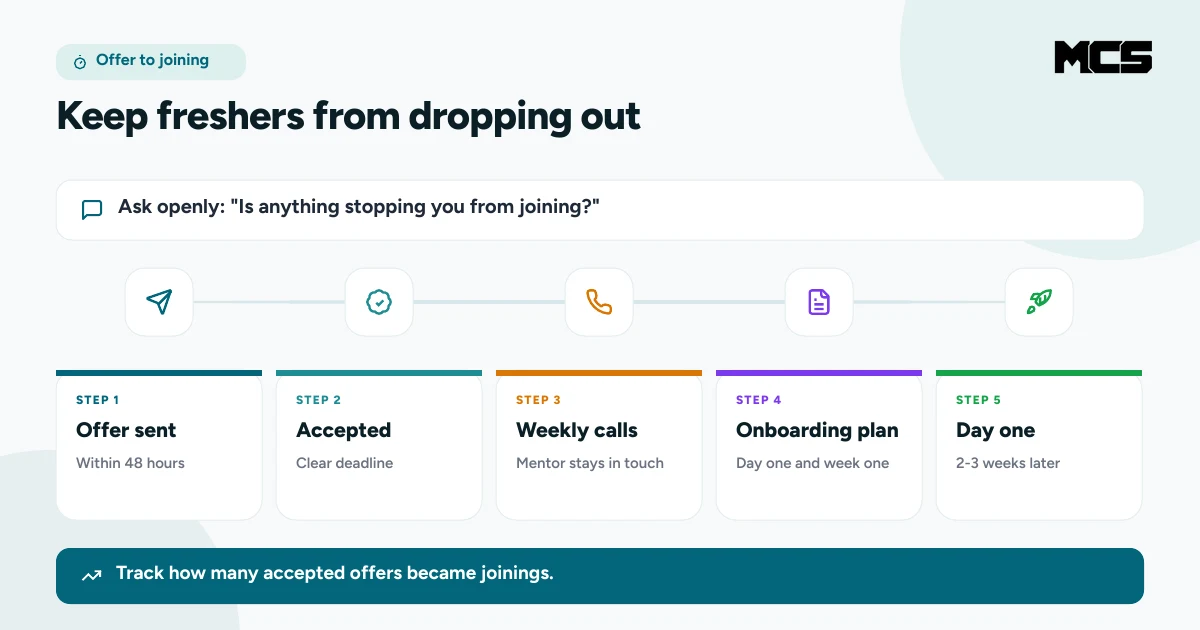
- Keep the joining date close: two to three weeks after acceptance is ideal for freshers who have finished college.
- Stay in touch every week: a short call from the mentor, an invite to a team lunch or a demo day, or a small pre-joining reading list.
- Send the laptop and onboarding plan early: tell them exactly what happens on day one and in week one.
- Ask directly about other offers: "Are you still interviewing elsewhere? Is there anything that would stop you from joining?" An honest question now saves a surprise later.
- Track every offer: note how many accepted offers became joinings and why people dropped. Fix the biggest reason first.
How to Hire Freshers for a Startup: 8-Step Checklist
- Write a one-page role brief: title, 90-day outcomes, 5 must-have skills, location, salary range, mentor.
- Turn it into a short, honest job post with title, city, salary and "freshers welcome" at the top.
- Post on your careers page and LinkedIn, share with 5-10 nearby colleges and ask your team for referrals.
- Post the role and search candidates on an employer portal such as the MCS employer portal.
- Shortlist resumes on projects, internships and links, not only college name or marks.
- Run a 15-minute phone screen, a 2-3 hour work task with a review call, and a final conversation.
- Send a clear offer within 48 hours with in-hand salary, 90-day plan and joining date.
- Stay in touch every week until day one, then run a planned first 30 days.
How My Career Solution Helps Employers
My Career Solution (MCS) works with job seekers across India, including many freshers and early-career candidates who are actively applying for jobs. For startups and HR teams, the MCS employer portal lets you:
- Post jobs and receive candidate applications in one place.
- Search candidates by role and skill.
- See the candidates MCS has sent to you, with their resumes, and message them from the portal.
- Use the resume checker to rank a large pile of resumes against your job description.
You can sign up at mycareersolution.com/employer/signup or log in at mycareersolution.com/employer/login. If you are a fresher reading this, you can browse open jobs, explore companies hiring, and see our interview call packages. Every new candidate gets free applications to 5 companies after signup.
FAQs
How can a startup hire freshers with a small budget?
Use low-cost channels: your careers page and LinkedIn, off-campus job posts, emails to nearby college placement cells, employee referrals and employer portals. Screen with one short work task instead of paid tests, and keep the process to about two weeks.
Is it a good idea for a startup to hire freshers?
Yes, if someone on the team can mentor them. Freshers learn your way of working, are usually available quickly and often grow with the company. If nobody has time to guide them, hire one experienced person first.
What should a startup test when hiring freshers?
Test learning speed, basic skills for the role and communication. A 2-3 hour task that looks like the real work, followed by a walkthrough call, shows all three better than a long aptitude test.
How do startups reduce offer drop-offs from freshers?
Send the offer quickly, keep the joining date close, explain the in-hand salary clearly, stay in touch every week before joining and share a clear plan for the first 30 days.
Should a startup choose campus hiring or off-campus hiring?
For 1-5 hires a year, off-campus hiring is usually faster and more flexible. Campus drives make sense when you hire freshers in batches and can plan around the college placement calendar.
Hiring freshers for your startup? Create your MCS employer account to post jobs and search candidates. Looking for your first job instead? See our interview call packages or read more guides on the MCS blog.
Frequently asked questions
How can a startup hire freshers with a small budget?
Use low-cost channels: your careers page and LinkedIn, off-campus job posts, emails to nearby college placement cells, employee referrals and employer portals. Screen with one short work task instead of paid tests, and keep the process to about two weeks.
Is it a good idea for a startup to hire freshers?
Yes, if someone on the team can mentor them. Freshers learn your way of working, are usually available quickly and often grow with the company. If nobody has time to guide them, hire one experienced person first.
What should a startup test when hiring freshers?
Test learning speed, basic skills for the role and communication. A 2-3 hour task that looks like the real work, followed by a walkthrough call, shows all three better than a long aptitude test.
How do startups reduce offer drop-offs from freshers?
Send the offer quickly, keep the joining date close, explain the in-hand salary clearly, stay in touch every week before joining and share a clear plan for the first 30 days.
Should a startup choose campus hiring or off-campus hiring?
For 1-5 hires a year, off-campus hiring is usually faster and more flexible. Campus drives make sense when you hire freshers in batches and can plan around the college placement calendar.