Accenture Interview Process for Freshers (2026): All Rounds, Questions and Prep Plan
Ankita · 13 Nov 2026 · Career & Interview Prep
Key Takeaways
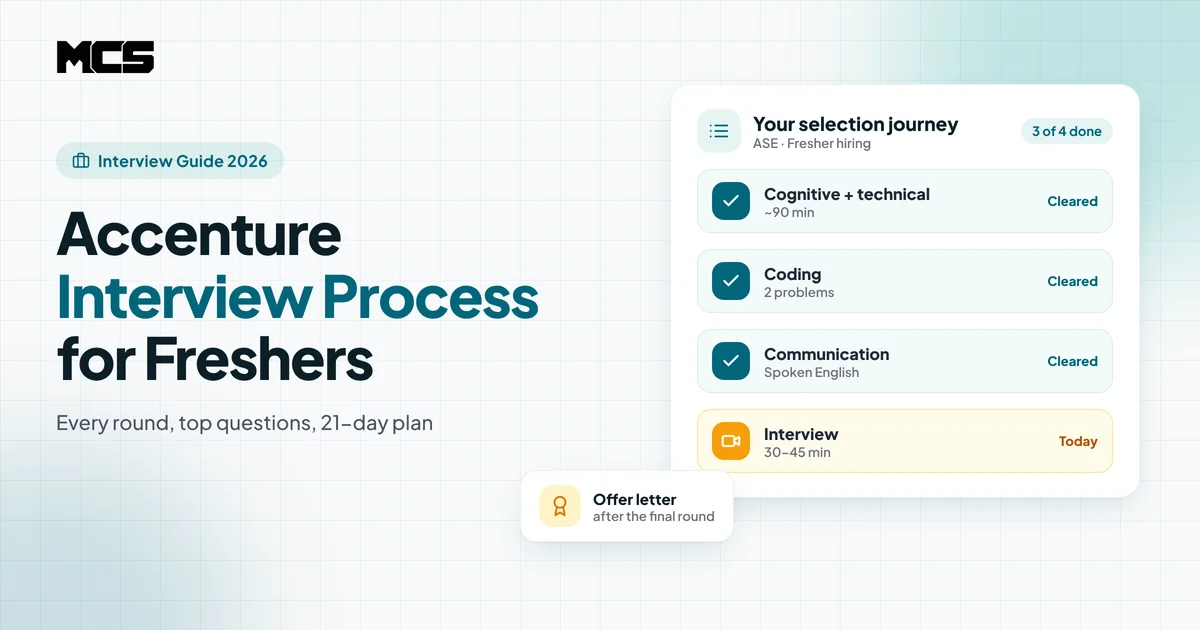
- The Accenture interview process for freshers usually has four stages: an online cognitive and technical assessment, a coding assessment, a spoken English (communication) assessment, and a final interview that mixes technical and HR questions.
- Most freshers join as Associate Software Engineer (ASE). Strong coding scores can open the higher-paid Advanced ASE track.
- The cognitive and technical test is the main elimination round. Coding questions are short and usually easy to medium level.
- The order of rounds, cut-offs and eligibility change from drive to drive. Always follow your invitation email and the official Accenture careers page.
- Accenture never charges freshers for a test, training or an offer letter. Anyone asking for money is not Accenture.
The Accenture interview process for freshers has four main steps: an online cognitive and technical assessment, a coding round, a communication (spoken English) assessment, and one final interview covering your projects, basic programming and HR questions. Clear all four and you get an offer for the Associate Software Engineer (ASE) or Advanced ASE role, usually within two to four weeks of the interview.
This guide walks through every round in the order most candidates see them, what each round tests, the questions freshers report most often, and a 21-day plan to prepare. It is written for B.E./B.Tech, MCA, M.Sc and similar graduates applying on campus or off campus in 2026.
Table of Contents
- Which roles does Accenture hire freshers for?
- Eligibility criteria for Accenture freshers
- Accenture interview process for freshers: all rounds
- Round 1: Cognitive and technical assessment
- Round 2: Coding assessment
- Round 3: Communication assessment
- Round 4: Technical + HR interview questions
- 21-day preparation plan
- Common mistakes that get freshers rejected
- How My Career Solution helps
- FAQs
Which roles does Accenture hire freshers for?
For engineering and computer graduates, Accenture's main fresher hiring in India is for two roles. Both start with the same online tests; your scores decide which one you are offered.
| Role | Who gets it | Package reported by candidates |
|---|---|---|
| Associate Software Engineer (ASE) | Candidates who clear all rounds | About ₹4.5 LPA |
| Advanced Associate Software Engineer (AASE) | Candidates with strong coding scores who clear a tougher interview | About ₹6.5 LPA, some sources report higher |
These figures come from candidate posts and prep sites, not from Accenture, and they change between drives. Treat your offer letter as the only final number. If you want to see how these packages compare with other companies, read our guide on software engineer fresher salary in India.
Eligibility criteria for Accenture freshers
Eligibility is set for each drive, so read the notice you are applying to. The rules most often listed for recent ASE drives are:
- Degree: B.E./B.Tech, M.E./M.Tech, MCA or M.Sc (CS/IT and related branches; many drives accept all branches).
- Marks: commonly 60% or 6.0 CGPA in 10th, 12th/diploma and graduation. Some 2026 guides mention 65%, so check your drive.
- Backlogs: no active backlog at the time of the test and at joining.
- Batch: only the passing years named in the notice (usually the current and previous year).
- Gap: education gaps are usually allowed only up to a limit and must be explained with documents.
- Previous attempt: if you took an Accenture test recently, you may have to wait (often reported as 6 months) before applying again.
Apply only through the official Accenture India careers page, your college placement cell, or a link from Accenture's verified recruiting email. You can also follow current openings on our Accenture company page.
Accenture interview process for freshers: all rounds
Here is the selection process as most 2025-26 candidates describe it. The order can change; some drives hold the communication test first, others after the coding round.
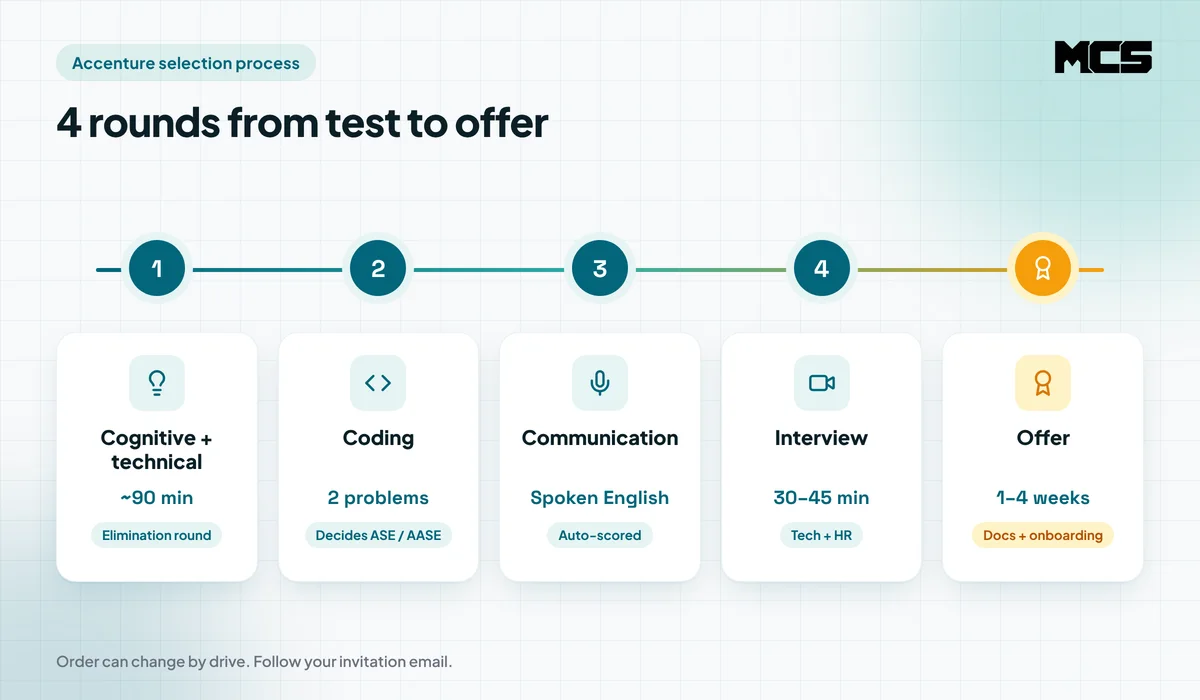
- Online application on the careers portal or through your college.
- Cognitive and technical assessment (elimination round).
- Coding assessment (decides ASE vs Advanced ASE for many candidates).
- Communication assessment (spoken English, graded automatically).
- Interview: usually one 30-45 minute round covering technical and HR questions.
- Offer letter, document check and onboarding.
Many candidates report taking the online rounds in one long sitting of about three to four hours. Keep water nearby, use a laptop with a working webcam and microphone, and test your internet before you start.
Round 1: Cognitive and technical assessment
This is the round that removes the most candidates. Prep sites describe a single test of roughly 90 minutes with two parts. There is usually no negative marking, but every section has its own timer, so you cannot come back to a section later.
Cognitive part
- English ability: reading comprehension, sentence correction, fill in the blanks, synonyms.
- Critical reasoning: statements and conclusions, arrangements, coding-decoding.
- Abstract reasoning: pattern series, odd one out, figure completion.
Technical part
- Pseudocode: read a short code snippet and predict the output. Loops, recursion and bit operations are common.
- Common applications: basic MS Word, Excel and PowerPoint questions.
- Networking, security and cloud basics: OSI layers, IP addresses, firewalls, what SaaS/PaaS/IaaS mean.
Tip: pseudocode carries a lot of weight. Practise dry-running small programs on paper, writing down variable values at each step.
Round 2: Coding assessment
The coding round usually gives two problems with around 45 minutes in total. You can choose a language such as C, C++, Java or Python. Candidates typically describe them as easy to medium level, for example:
- Array problems: second largest element, sum of elements at even positions, rotate an array.
- String problems: count vowels, reverse words, check a palindrome.
- Simple maths: prime numbers in a range, digit sum, GCD.
Getting one problem fully correct and the second partly correct is often enough to move ahead. Solving both cleanly, with all hidden test cases passing, is what candidates say helps them reach the Advanced ASE interview. Read the input and output format twice; most wrong answers come from printing extra spaces or wrong formats.
Round 3: Communication assessment
This is a recorded spoken English test, scored by software. You speak into your microphone, so a quiet room matters. Candidates commonly describe these sections:
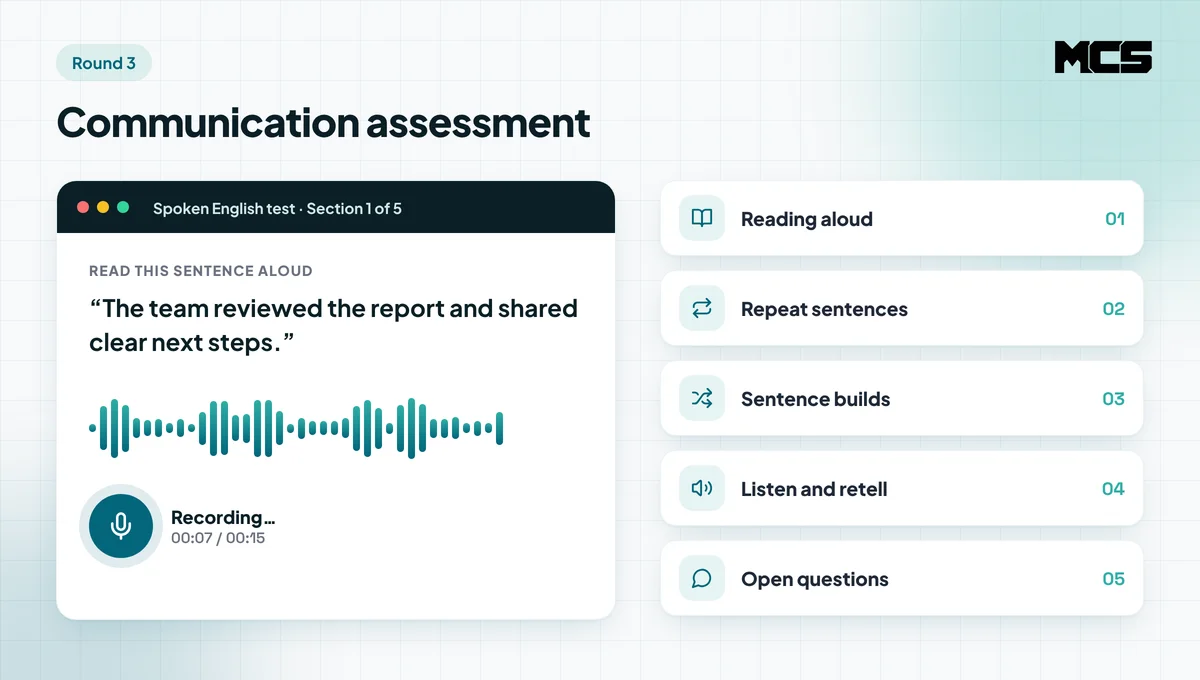
- Reading aloud: read sentences clearly at a natural speed.
- Repeat: listen to a sentence and repeat it exactly.
- Sentence builds: rearrange jumbled phrases into a correct sentence and speak it.
- Short answers and story retelling: listen to a short passage and retell it in your own words.
- Open questions: speak for 30-60 seconds on a simple topic.
The software checks pronunciation, fluency, grammar and whether you complete the task. You do not need a special accent. Speak at a steady pace, avoid long pauses and do not restart sentences. Practise by recording yourself reading a news article for five minutes a day.
Round 4: Technical + HR interview questions
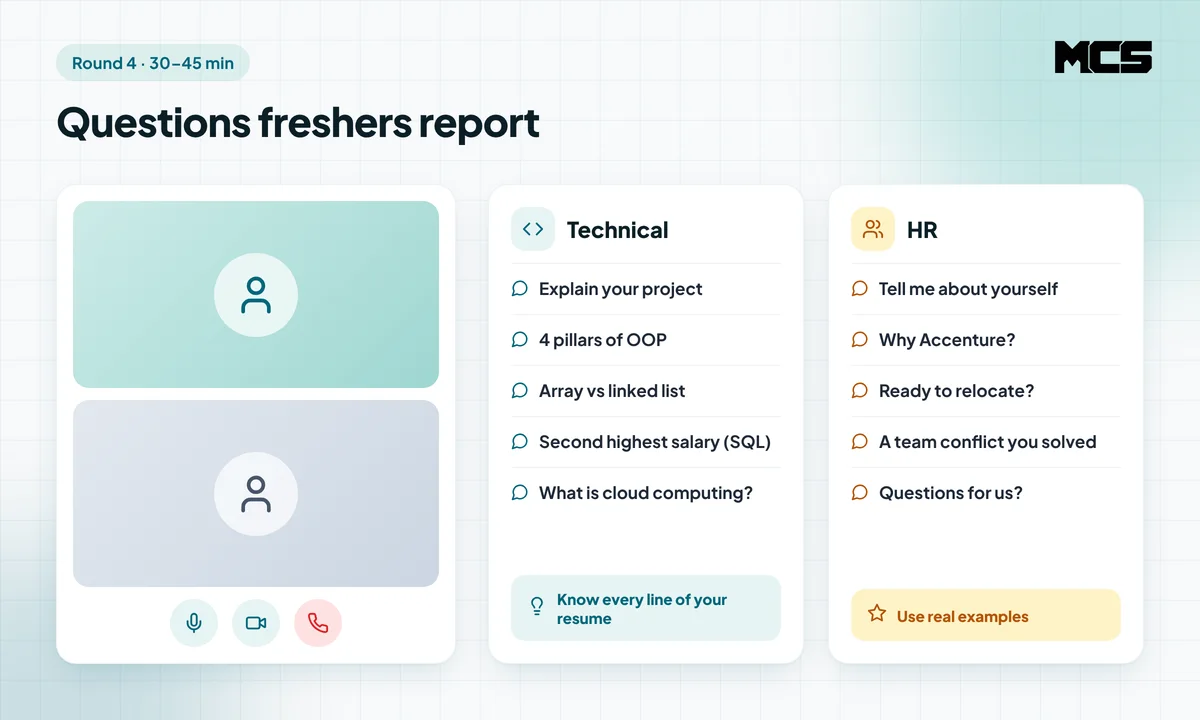
Most ASE candidates get one combined interview on video, usually 30 to 45 minutes. Advanced ASE candidates may face a harder technical discussion. Expect the interviewer to start with your introduction, go deep into one project, and then ask basics and HR questions.
Technical questions freshers report
- Explain your final-year project. What was your role, and what would you improve?
- What are the four pillars of OOP? Give an example of polymorphism.
- Difference between an array and a linked list; stack and queue.
- Write a program to reverse a string or check for a palindrome (often shared on screen).
- What is a primary key and a foreign key? Write a query to find the second highest salary.
- What is the difference between
DELETE,TRUNCATEandDROP? - What is cloud computing? Name one service you have used.
- What happens when you type a URL in the browser?
HR questions freshers report
- Tell me about yourself. (Use our tell me about yourself answer guide for freshers.)
- Why Accenture? What do you know about our work?
- Are you willing to relocate and work in shifts?
- Tell me about a time you worked in a team and there was a disagreement.
- Where do you see yourself in five years?
- Do you have any questions for us?
For more model answers, read our full list of HR interview questions for freshers. Your resume drives most of the technical discussion, so keep only projects you can explain line by line. Our resume format for software developer freshers shows what to include.
21-day preparation plan for the Accenture interview process
Three weeks of steady practice is enough for most graduates to attempt the tests seriously. Spend about two to three hours a day.
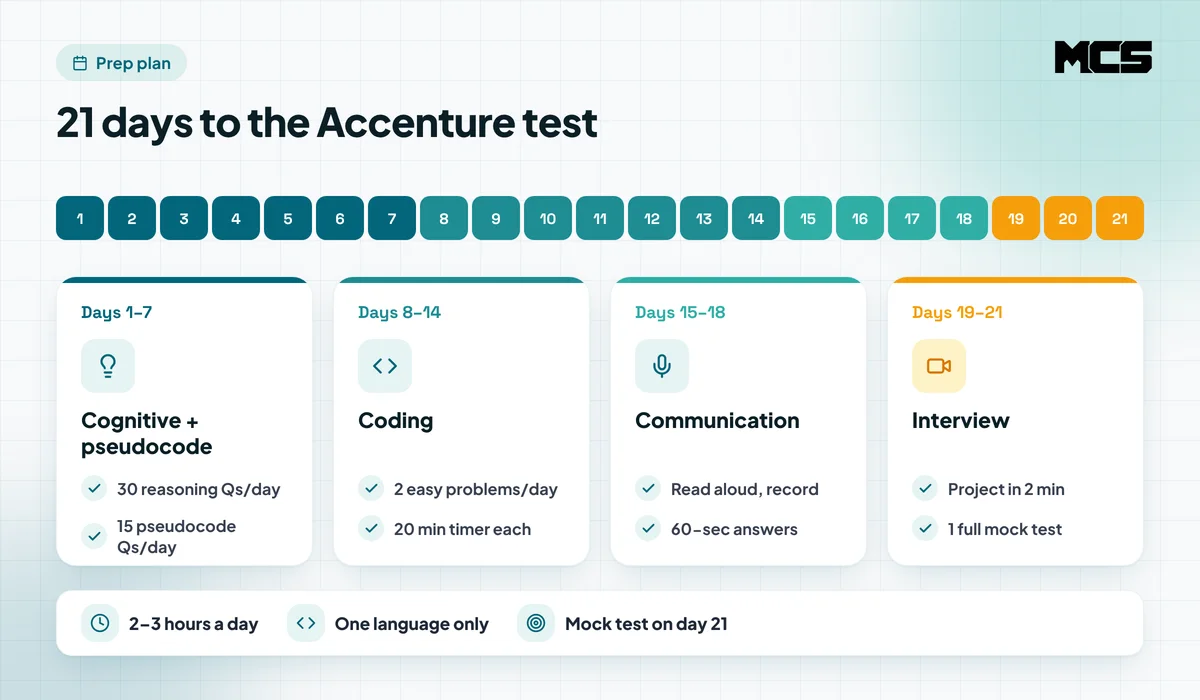
| Days | Focus | What to do |
|---|---|---|
| 1-7 | Cognitive + pseudocode | 30 English and reasoning questions a day; 15 pseudocode output questions a day; revise networking and cloud basics. |
| 8-14 | Coding | Two easy array or string problems a day in one language, timed at 20 minutes each; learn to handle edge cases (empty input, one element). |
| 15-18 | Communication | Read aloud for 10 minutes, record and listen back; practise repeating sentences and speaking for 60 seconds on simple topics. |
| 19-21 | Interview | Prepare a 60-second introduction, a 2-minute explanation of each project, OOP/DBMS/SQL basics and 5 HR answers; do one full mock test. |
Checklist for test day
- Laptop charged, webcam and microphone tested, browser updated.
- Quiet room, no one else in the frame, phone kept away.
- College ID and government ID ready.
- Read every instruction screen; note the time for each section.
Common mistakes that get freshers rejected
- Spending too long on one question in the cognitive round. Each section has its own timer; skip and move on.
- Ignoring pseudocode. Many freshers practise aptitude only and lose easy marks here.
- Background noise in the communication test, which lowers the automatic score.
- Copied projects on the resume that you cannot explain in the interview.
- Mismatched details between your application form, resume and mark sheets. These can block your offer at document check.
- Falling for fake offers that ask for a fee. Accenture's process is free.
Accenture is one strong option, but do not depend on a single company. Apply to other service and product companies in parallel; see our lists of top IT companies in India for freshers, our guide to getting a job in TCS as a fresher, and tips for off campus drives. You can also browse companies like Infosys, Wipro and Cognizant.
How My Career Solution helps
Clearing a test is only half the job; you also need enough interview calls. My Career Solution sends your profile and resume directly to recruiters at companies that match your skills, so you are not relying on one drive.
- Free start: when you sign up and click to apply, we send your profile to 5 matching companies free.
- Interview call packages: paid plans come with guaranteed interview calls based on the package you choose. See the details on our packages page.
- Live jobs and companies: browse fresh openings on MCS jobs and company profiles on MCS companies.
Before you apply anywhere, make sure your resume passes ATS filters with our ATS-friendly resume guide for freshers, and read how to get interview calls as a fresher.
FAQs
How many rounds are there in the Accenture interview process for freshers?
Usually four: a cognitive and technical assessment, a coding assessment, a communication assessment and one interview that covers technical and HR questions. Some drives split the interview into separate technical and HR rounds.
Is the Accenture coding round difficult?
Most candidates describe it as easy to medium. You get two problems on arrays, strings or simple maths. Solving both fully helps you reach the Advanced ASE track.
What is the salary of Accenture ASE for freshers?
Candidates commonly report about ₹4.5 LPA for ASE and about ₹6.5 LPA for Advanced ASE. These are not official figures, so rely on your offer letter.
Is there negative marking in the Accenture test?
Candidates and prep sites generally report no negative marking, but each section is timed separately, so time management matters more than guessing.
How long does Accenture take to send an offer letter after the interview?
Many candidates report getting results within one to four weeks of the interview. Joining dates can come months later, depending on business needs.
Ready to get more interview calls? See My Career Solution packages or browse the latest fresher jobs, and read more guides on the MCS blog.
Frequently asked questions
How many rounds are there in the Accenture interview process for freshers?
Usually four: a cognitive and technical assessment, a coding assessment, a communication assessment and one interview that covers technical and HR questions. Some drives split the interview into separate technical and HR rounds.
Is the Accenture coding round difficult?
Most candidates describe it as easy to medium. You get two problems on arrays, strings or simple maths. Solving both fully helps you reach the Advanced ASE track.
What is the salary of Accenture ASE for freshers?
Candidates commonly report about ₹4.5 LPA for ASE and about ₹6.5 LPA for Advanced ASE. These are not official figures, so rely on your offer letter.
Is there negative marking in the Accenture test?
Candidates and prep sites generally report no negative marking, but each section is timed separately, so time management matters more than guessing.
How long does Accenture take to send an offer letter after the interview?
Many candidates report getting results within one to four weeks of the interview. Joining dates can come months later, depending on business needs.